Videatives Views Blog

Issue #57: Playground Physics

May 6th, 2008

See What Children Know

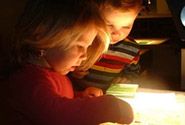
Videative Views VideoWhen children play outdoors, they are doing more than developing their gross motor skills and self-confidence.  They are also experimenting with the physics of their bodies on swings, seesaws, jungle gyms, and in this case, a tilting board on a green pipe.

Brayden, age four, experiments with a board that tilts, depending on which side holds more of his weight. Here are possible thoughts that Brayden has as he experiments with the balance board. Note the amazing amount of thinking that is involved in these two minutes of play. 

The following possible thoughts are arranged in the order that they occur in the video clip.  See if you can find the behavior that matches Brayden’s possible thoughts, or let us know if you have different interpretations, or how you might redesign the balance board.

  1. I am more stable if I crawl on all fours up the ramp.
  2. If I am blocked because the board on my end is up, I can push it down.  I know it will go down because I just saw it go up.
  3. If I don’t want to lose my balance by pressing the board down with my foot, I can enter the ramp on the other side where the board is already down.
  4. If I want to make the board change its tilt, the best place to stand is in the middle with one foot on each side of the green tube.
  5. To make the board change its tilt, I need to slowly transfer weight from my downhill foot to my uphill foot.
  6. I now know the feeling of the board, so now I will press on the uphill side of the board instead of walking to the other side.
  7. Once I make the uphill side go down, I can reverse the tilt by transferring weight back to my uphill foot, the one that was downhill before the tilt.
  8. Actually, I don’t have to walk up the ramp to play my game.  I can enter directly at the middle of the board from the ground.  This strategy eliminates the probability that I will lose my balance as I walk up the incline.
  9. Instead of alternating upside to downside back and forth, I will try to make the board pause more in a horizontal position with my weight distributed equally on both sides of the green pipe.
  10. To make the board pause in the middle I need to press down with my uphill foot, but at the same time I should not shift weight too quickly from my downhill foot.
  11. Perhaps if I put my uphill foot further uphill I will have more control over the abruptness of the tilt.
  12. If I can’t make the board pause in a balanced position, let me quickly test the back and forth limits of down, up, down, up.
  13. I need to replace the board that fell off such that the green pipe is under the middle of the board.
  14. Yes, when I put my uphill foot further uphill, the board seems to tilt more slowly.
  15. I have tried and had a good time, but I think I will stop. 

Not only does Brayden’s behavior reveal his theories about playground physics, but also these theories themselves are based on a sensori-motor logic described most clearly by Jean Piaget.  For example, Brayden’s transition, around #10, indicates a new type of thinking called renversibilite’.  A child’s thoughts are said to have renversibilite’ when the child understands that one action can serve two opposing functions.  In #10 Brayden understands that he must press down with his uphill foot, to make the board go down, but he must also hold back a bit so that the board will not go down too far.  This type of two-way thinking is a milestone in cognitive development and is fundamental to understanding higher forms of logic later in life.  To learn more about the logic of action, you may download our eBook Constructive Play.  In this eBook there are many examples of objects and games that activate high-level thinking and sensori-motor logic. 


Notes From the Field

If you would like to see the full presentation that Ellen and George made at Google, go to our home page at www.videatives.com and click on the link under Videatives News and Events.  The title of the talk, on the YouTube video is, “Playing Your Way to Harvard.”  The title of the talk at Google was actually, “Skipping Your Way to Harvard.”  We apologize for the confusion; titles aside, we discussed how play is essential for both understanding and love of work.  There is a Q&A session during the last 40 minutes of the YouTube video.  Your comments are welcomed.  Please feel free to link this video to your child development courses and/or teacher education sessions. 

One Response to “Issue #57: Playground Physics”

  1. Leslie Says:

    I find this video a delight in so many ways. Here we watch the child scaffolding his thinking without “teacher” direction. Another piece that captured my attention was the silent dialogue between the child and videographer. The silent dialogue seems to be also scaffolding the child. We see him checking in visually with the videographer after each level of difficulty is accomplished as if to see if the historic moment is being captured for posterity. This is one reason I love using video when a child is in a very silent way understanding and valuing the role of videographer. It is as if the act of video taping is a silent provocation for the child to keep going, keep thinking, think another way, and the child trusts that the videographer stays in the moment to capture it!

    What next? I wonder what would happen if a variety of larger and or smaller diameter pipes were offered along with planks of various lengths. I think the size of the pipe here didn’t allow the child to get to the point of balancing the plank perfectly flat. I remember doing this on the teeter totter as a child, making it stay without going up or down was always my quest. It would be fun to add a square log or a wedge perhaps in midst making or pushing them to think about the plank and the foundation. Here we could push the challenge of physics and thinking more.

Leave a Reply